
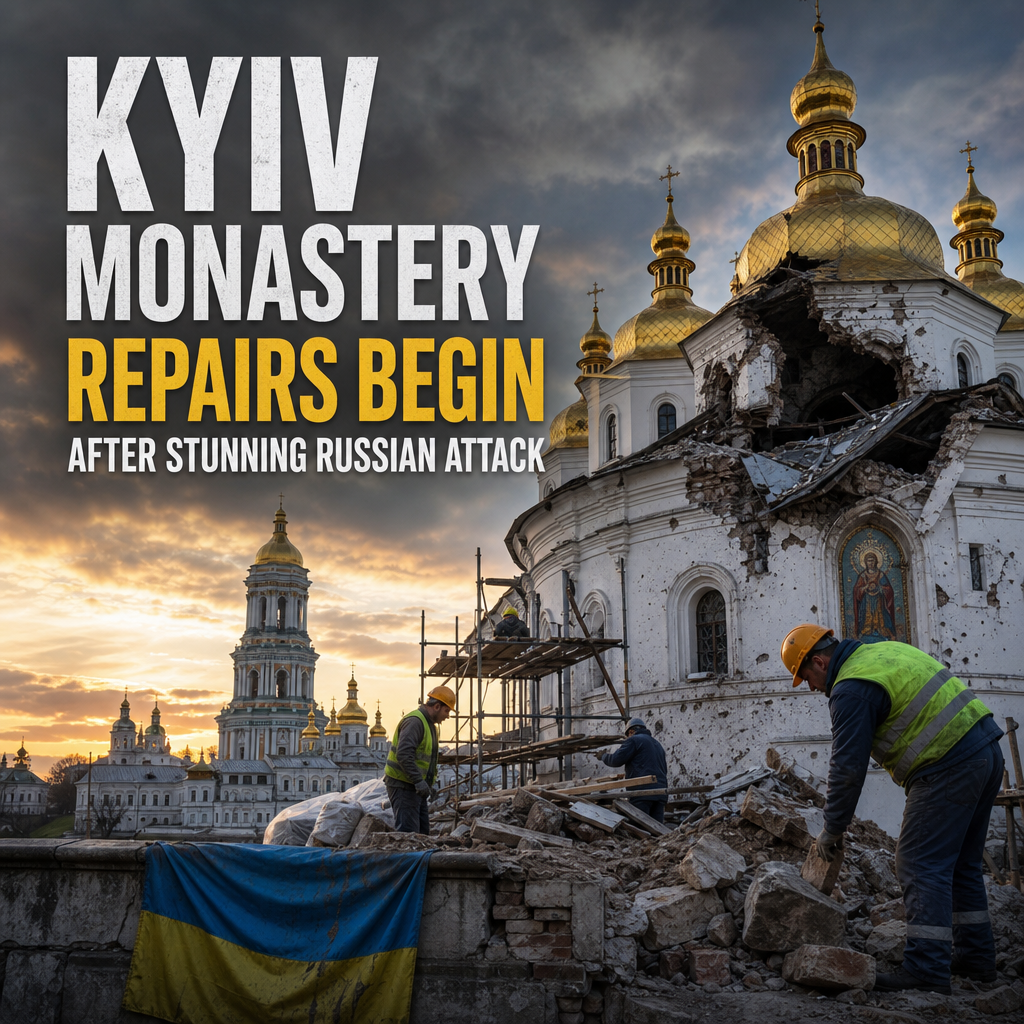
Kyiv Monastery Repairs Begin After Stunning Russian Attack


Kyiv Monastery repairs begin after stunning Russian attack, marking not just a practical restoration effort but also a symbolic fight to protect Ukraine’s cultural memory under fire. The damage to a 1,000-year-old religious site has prompted fresh outrage, renewed questions about the protection of heritage during war, and another reminder that attacks on historic landmarks carry consequences far beyond the physical destruction they leave behind.
The immediate story is straightforward enough: emergency repairs are underway after the strike damaged part of the monastery complex, a place that is deeply important to Ukrainians both spiritually and historically. But the meaning of the attack is anything but simple. In coverage across international outlets, the incident sits at the intersection of war reporting, cultural preservation, and propaganda warfare. One side sees a deliberate assault on identity; another frames the broader conflict in terms of military necessity and competing claims about targets. The result is a familiar but painful wartime pattern: even when facts about damage are clear, motives and responsibility are contested in the information space.



Kyiv Monastery repairs begin after stunning Russian attack: why the site matters
The monastery’s significance helps explain why the strike resonated so strongly. A complex with roots stretching back centuries is not merely a tourist attraction or a religious building. It is a living symbol of Kyiv’s history, Ukrainian Orthodoxy, and the endurance of the city itself. When such a site is hit, the damage is measured not only in broken stone and shattered windows, but in public grief and fear that the war is eroding the foundations of national heritage.
That reaction has been echoed across reporting that centers on Ukraine’s perspective. The emphasis is often on preservation: keeping the monastery structurally safe, preventing further deterioration, and documenting the damage for future restoration. These practical tasks matter because wartime repairs are rarely straightforward. Specialists must stabilize vulnerable sections quickly, often while the danger of renewed attacks remains. In other words, restoration begins under conditions that would make ordinary conservation nearly impossible.




At the same time, the public response is about more than bricks and mortar. For many Ukrainians, the attack reinforces a broader belief that Russia’s war is not limited to the battlefield. Cultural sites, churches, museums, and monuments have become part of the narrative of survival. That does not automatically prove intent in every case, but it does explain why each strike on a landmark is treated as an assault on national identity.
Competing narratives around the strike
Different news sources tend to frame these events in sharply different ways, and this case is no exception. Western and regional coverage usually highlights the heritage loss, civilian concern, and the vulnerability of historic places in a modern war. Such reporting tends to ask whether international law protecting cultural property is being respected, and whether enough is being done to prevent further damage.
Russian state-aligned coverage, by contrast, often presents the war through a very different lens. It may emphasize military targets, insist that strikes were aimed at strategic infrastructure rather than cultural landmarks, or challenge the reliability of Ukrainian claims. That does not mean every Russian account is identical, but the consistent pattern is to narrow the meaning of the attack and dispute the broader moral framing offered by Kyiv and its allies.
This split matters because it shapes how the public understands accountability. If a monastery is described as collateral damage, the event is treated as a tragic side effect of war. If it is presented as a deliberate or reckless strike on heritage, the event becomes part of a larger condemnation of Russia’s conduct. The truth may lie partly in the evidence available and partly in what investigators can later verify, but the war of narratives begins long before any formal assessment is complete.
What the repairs say about Ukraine’s wartime priorities
There is also a quiet lesson in the fact that repairs begin so quickly. Ukraine is not waiting for peace to start preserving what can be saved. That approach reflects both necessity and symbolism:
– it reduces the risk of further structural collapse
– it signals that the site will not be abandoned to destruction
– it reassures worshippers, residents, and visitors that the monastery remains part of Kyiv’s living cityscape
– it preserves evidence that may later be important for damage assessment and accountability
The speed of the response also underlines how cultural resilience has become a wartime priority. Ukraine has repeatedly tried to show that the country is not just defending territory, but the institutions, traditions, and landmarks that make that territory meaningful. In that sense, restoration work is a form of resistance.
Still, it would be misleading to romanticize the process. Repairs after shelling or missile damage are costly, technically difficult, and often incomplete. Some damage may remain visible for years. Conservation teams must balance historical authenticity against emergency safety. And because the war is ongoing, every repaired wall remains exposed to future risk.
A broader warning for heritage in war
The attack on the monastery is part of a wider global concern: historic and religious sites are increasingly vulnerable in modern conflicts. International rules exist to protect cultural property, but enforcement is weak when war is active and the truth is disputed in real time. That makes local documentation, independent reporting, and careful repair work especially important.
The strongest conclusion from the available reporting is not that every detail is settled, but that the incident is deeply consequential no matter how one interprets the targeting. Even if future investigations clarify the exact circumstances, the damage to a centuries-old monument already tells its own story. It shows how war can reach into the oldest corners of a city and force communities to defend not just their present, but their past.
For now, the repairs underway at the monastery stand as a reminder that reconstruction in Ukraine is not only about infrastructure. It is about preserving continuity in a place where continuity has been violently interrupted. And that is why this story matters well beyond Kyiv.